



This study aimed to examine lower-limb strength and power using a pneumatic leg press test in elite male football players prior to their reintegration into team training following a thigh muscle strain injury and to compare their performance with that of injury-free controls.
MethodsNormative values for maximal strength (Fmax) and power (Ppeak) from 70 injury-free players were compared with those from 20 players at the end of the on-field rehabilitation stage following muscle strain injuries of the hamstrings, quadriceps or hip adductors.
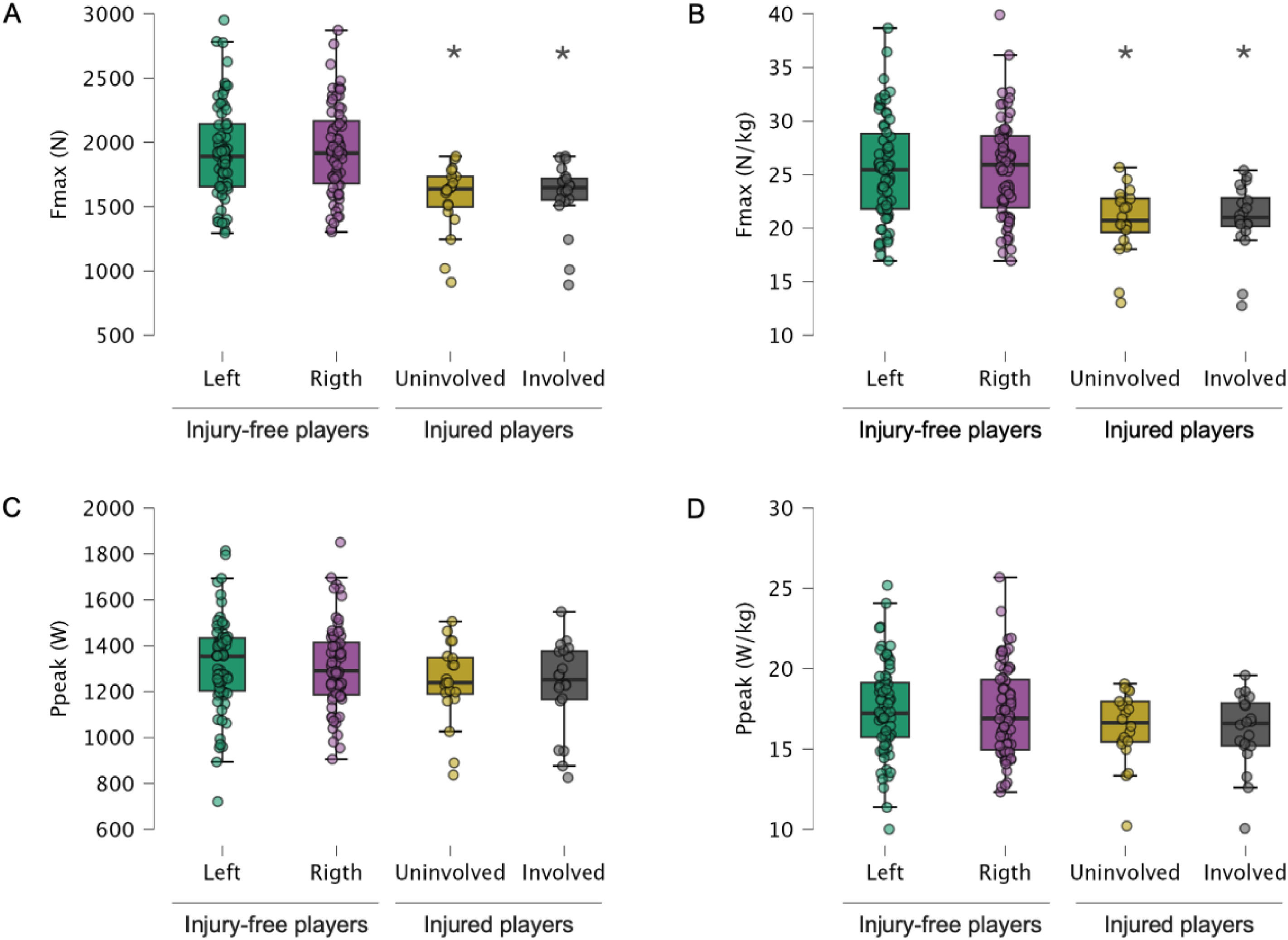
ResultsInjured players exhibited symmetrical Fmax (1590 ± 264 N vs. 1569 ± 259 N) and Ppeak (1226 ± 195 W vs. 1239 ± 173 W) values between involved and uninvolved limbs. Ppeak values in the injured group were also comparable to those observed in the left (1319 ± 201 W) and right limbs (1310 ± 184 W) of injury-free players. In contrast, both limbs of injured players demonstrated significantly lower Fmax values than the left (1932 ± 373 N) and right limbs (1939 ± 352 N) of the injury-free group (p < 0.001).
ConclusionsThese findings suggest that interlimb symmetry should not be interpreted in isolation but considered alongside pre-injury or normative reference values to support more informed return-to-sport decisions when using the pneumatic leg press test.
Muscle strain injuries present a significant challenge to healthcare staff in elite football (soccer). While the overall injury rate decreased by 3% per season from 2000/2001 to 2018/2019 among European elite teams, muscle injury rates remained unchanged.1 Hamstring strains are the most frequent, representing 17% of all injuries, while hip adductor and quadriceps account for 9% and 6%, respectively.2 Although most muscle injuries typically sideline players for less than a month,3 they can have a substantial impact on clubs. For example, during the 2018/2019 season, Spanish top-tier clubs incurred monthly player salary costs due to muscle injuries ranging from €15.5 thousand to €2.3 million.4 The absence of injured players negatively affects team performance and championship prospects,5 resulting in additional financial losses. Given the high re-injury rate of muscle strains, especially within two months of returning to sport,6 clubs' healthcare staff must implement optimized rehabilitation programs that enable athletes to return to the field quickly while ensuring appropriate physical and technical conditioning and minimizing the risk of re-injury.
Recent research has yielded advancements in the rehabilitation of athletes with muscle injuries.7,8 There is growing agreement that injured athletes should follow a criterion-based process through clinical rehabilitation, on-field rehabilitation (OFR), reintegration into team training, return to competitive match play, and ultimately a return to full performance.9 OFR serves as a bridge between healthcare and coaching staff. Although practitioners in football clubs have employed OFR for a considerable time, relatively recent conceptual frameworks have enhanced the organization of this crucial stage for athletes' functional recovery.10,11 Buckthorpe et al.10 proposed a four-pillar structure for developing OFR programs that emphasize movement quality, physical conditioning, sport-specific skills, and training workload. Meanwhile, Taberner et al.11 introduced the 'control-chaos continuum,' a five-stage framework for progression leading up to the full return to sport.
Overall, OFR represents the final stage of an athlete's functional recovery before returning to field-based activities with the team. Ideally, the objective is for the athlete to return without significant deficits in essential physical components. A football match involves repeated explosive efforts such as short sprints, rapid accelerations and decelerations, jumps, kicking and tackling.12 Consequently, strength and power are considered highly important in this context.13 Maximum strength is the highest force that can be exerted during a maximum voluntary contraction, whereas power output refers to the rate at which mechanical work is performed.14 The evidence regarding the relationship between these neuromuscular components and the risk of muscle injuries remains inconsistent. However, some prospective studies indicate that lower maximum strength15–19 and power19 are associated with an increased risk of muscle injuries. In addition, interventions targeting improvements in muscle strength have been effective in preventing hamstring20 and adductor21 strain injuries.
Strength and power tests have been extensively used to inform return-to-sport decision-making after muscle injuries.22–24 Practitioners often use the performance of the contralateral limb as a reference to evaluate the status of the injured limb, with a difference of up to 10% typically regarded as an acceptable level of symmetry.25 Although strength and power can be assessed using isokinetic dynamometry,26 closed-kinetic-chain tests may provide greater ecological validity by more closely mimicking the motor tasks encountered in football. Accordingly, one-repetition maximum tests and vertical jumps have been proposed as effective options for evaluating maximal strength and power, respectively.26
The Keiser A420 leg press (Keiser Corporation, Fresno, USA) is a pneumatic resistance-based seated leg press machine featuring independent left and right footplates. The device measures force and movement velocity for each footplate, allowing power output to be calculated during a functional closed-kinetic-chain task involving simultaneous knee and hip extension. This testing approach enables the assessment of single-limb force and power and interlimb symmetry within a single protocol, which may be particularly relevant in rehabilitation and return-to-sport contexts.
Redden et al.27 demonstrated the test–retest reliability of the Keiser A420 and were among the first to provide reference values from a sample of 13 professional football players. However, the literature still lacks studies with larger samples, and evidence regarding the performance of athletes undergoing rehabilitation remains scarce. Therefore, this study aimed to examine lower-limb strength and power using a pneumatic leg press test in elite male football players prior to their reintegration into team training following a thigh muscle strain injury and to compare their performance with that of injury-free controls.
MethodsStudy designThis retrospective study utilized data collected from routine testing conducted between 2021 and 2023 by the healthcare staff of two professional male football clubs. Normative values for maximum strength and power in the pneumatic leg press test were established from pre-season assessments conducted on injury-free players. The test was also administered to players who sustained thigh muscle strain injuries during the season, specifically at the end of the OFR, just before being cleared to be reintegrated into team training. The present study is part of a broader umbrella research project aimed at identifying risk factors for musculoskeletal injuries in football players (Ethics Committee of the Federal University of Health Sciences of Porto Alegre, Brazil). The use of the retrospective data for scientific purposes was approved by the club boards, and all information was anonymized to ensure participant confidentiality.28
ParticipantsThis study involved professional male football players from two elite clubs in Brazil. During the study period, the teams competed in the Brazilian top-tier league and participated in continental South American competitions, including Copa Libertadores de América and Copa Sudamericana. The normative values for the pneumatic leg press test were established based on assessments conducted during the pre-season. Injury-free players who were actively participating in the training routine without complaints or discomfort were included in the analysis. The club records provided anthropometric data, including body mass, height, and age, as well as player positions categorized as goalkeepers, defenders, midfielders, and forwards.
From the clubs’ medical records, we selected players who sustained muscle strain injuries in the thigh, primarily in the hamstrings, quadriceps, and hip adductor muscles. The strains were required to bestructural muscle injuries, classified as type-3 according to the Munich consensus statement29 by the club’s medical doctor based on clinical examination and imaging. The injury details reviewed included the involved muscle group, the side (preferred or non-preferred limb), and the severity, which was classified based on the number of absence days: mild (up to 7 days), moderate (8 to 28 days), or severe (>28 days).30
The pneumatic leg press test was part of the testing battery used in both participating clubs to support the decision-making process for progressing the athlete from OFR to team training. Because the pneumatic leg press test was not used as the sole criterion, players could be cleared to reintegrate into team training even if they performed poorly on the test. The health staff of participating clubs did not perform the test due to practical constraints in a few sporadic cases. Therefore, only athletes with thigh muscle strain injuries who completed the pneumatic leg press test at the final stage of OFR were included. It means that all players were cleared to advance to full unrestricted training with the team either immediately or within 2 days following the evaluations, depending on the team’s training schedule.
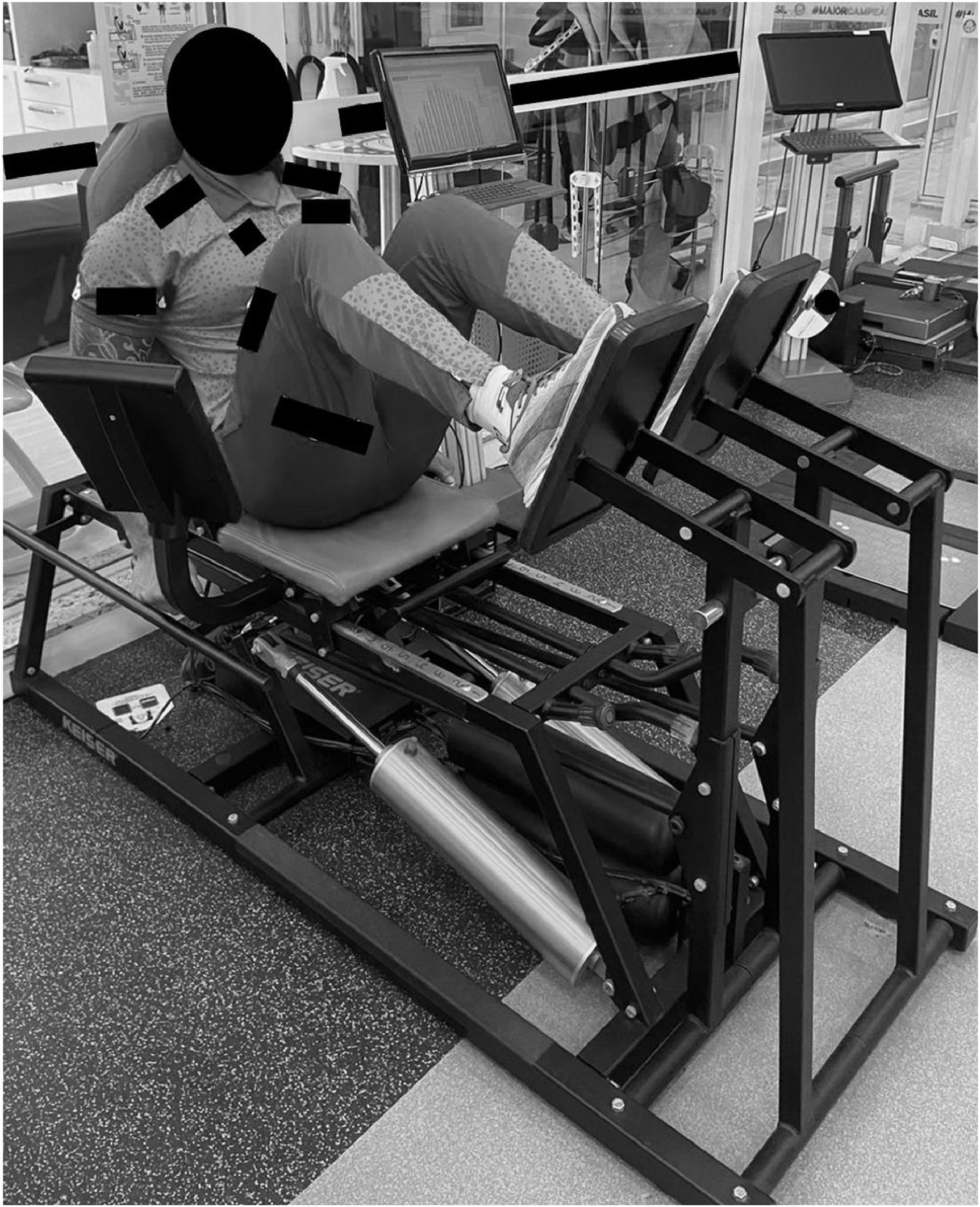
Pneumatic leg press testLower limb performance was assessed using the Keiser A420 horizontal pneumatic leg press device (Keiser Corporation, Fresno, USA), equipped with an in-built force and velocity measuring software (Fig. 1). The depth of the seat was individually adjusted to ensure the appropriate seating position (approximately 90° of knee flexion) with the heels positioned at the lower end of each foot pedal. The leg press was performed as a concentric-only action without countermovement, with the subsequent eccentric phase being submaximal and not recorded. Each ‘push’ movement was executed bilaterally, with the device providing pneumatic resistance and collecting individual data for each pedal. Participants performed a 5-minute general warm-up on a cycle ergometer at moderate intensity followed by three to five submaximal repetitions on the pneumatic leg press for familiarization and specific warm-up.
The ‘Keiser 10-repetition force–velocity profiling test’27,31–33 involved performing multiple leg press repetitions against progressively increasing resistances corresponding to 15%, 27%, 35%, 45%, 54%, 63%, 72%, 82%, 91%, and 100% of the estimated maximum resistance. The estimated maximum resistance was set in the Keiser A420 software based on participants’ results from previous exposure tests (or the group average when no prior data were available). The protocol was performed until task failure, defined as the point at which the participant was no longer able to move the pedals. Because resistance increased progressively across repetitions, some participants completed fewer than ten repetitions, whereas others required additional repetitions beyond 100% of the estimated maximum resistance until failure was reached. Consequently, the total number of repetitions varied between participants, typically ranging from 8 to 12.
Each repetition generated a force–velocity data point for each limb. All valid repetitions recorded by the device were used to construct the individual force–velocity relationship. Repetitions with a clear technical error were excluded from the analysis. The rest time between repetitions expanded with increasing resistance loading, ranging from 10 to 40 s. Participants were asked to complete each repetition by extending both limbs together with maximum velocity and instructed to ‘push as fast and as evenly as possible’.
Outcomes‘Maximum Force’ (Fmax) was estimated by fitting a linear regression to all force–velocity data points obtained during the test and extrapolating the relationship to a velocity of 0 m·s⁻¹ for each limb individually, representing maximal force capacity .[intraclass correlation coefficient (ICC) = 0.88–0.93; coefficient of variation (CV) = 3.9–5.1%].27‘Peak Power’ (Ppeak), defined as the highest power output achieved across all repetitions during the test for each limb individually, was used to represent maximal power capacity (ICC = 0.85–0.90; CV = 5.28–5.30%).27 The ‘Limb Symmetry Index’ (LSI), a metric commonly used to compare the performance between limbs, was calculated for injury-free players as: (left limb ÷ right limb) × 100.25 For players at the end of OFR following a muscle strain injury, the LSI was calculated as: (involved limb ÷ uninvolved limb) × 100.25
Statistical analysesDescriptive statistics (mean, standard deviation, and 95% confidence intervals) were used to describe participants’ performance on the pneumatic leg press test. The Shapiro–Wilk test and Levene’s test were used to assess normality of data distribution and homogeneity of variances, respectively. A one-way ANOVA, followed by a Bonferroni post-hoc test, was conducted to compare Fmax and Ppeak across the right and left limbs of injury-free players and the involved and uninvolved limbs of injured players. A Mann-Whitney U test was used to compare LSI between injury-free and injured players. Statistical significance was set at 5% (p < 0.05). For comparisons showing statistically significant differences, effect sizes were calculated using Cohen’s d to quantify the magnitude of the differences between groups. The effect sizes were interpreted according to conventional thresholds, with values of 0.2, 0.5, and 0.8 representing small, moderate, and large effects, respectively. All statistical analyses were performed using JASP 0.95.4 software.
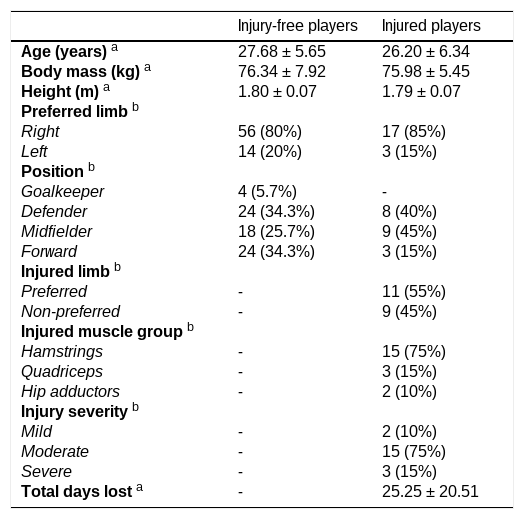
ResultsSeventy professional male football players took part in the injury-free group, providing normative values for comparison with the 20 players included in the injury group (Table 1).
Characteristics of participants.
| Injury-free players | Injured players | |
|---|---|---|
| Age (years) a | 27.68 ± 5.65 | 26.20 ± 6.34 |
| Body mass (kg) a | 76.34 ± 7.92 | 75.98 ± 5.45 |
| Height (m) a | 1.80 ± 0.07 | 1.79 ± 0.07 |
| Preferred limb b | ||
| Right | 56 (80%) | 17 (85%) |
| Left | 14 (20%) | 3 (15%) |
| Position b | ||
| Goalkeeper | 4 (5.7%) | - |
| Defender | 24 (34.3%) | 8 (40%) |
| Midfielder | 18 (25.7%) | 9 (45%) |
| Forward | 24 (34.3%) | 3 (15%) |
| Injured limb b | ||
| Preferred | - | 11 (55%) |
| Non-preferred | - | 9 (45%) |
| Injured muscle group b | ||
| Hamstrings | - | 15 (75%) |
| Quadriceps | - | 3 (15%) |
| Hip adductors | - | 2 (10%) |
| Injury severity b | ||
| Mild | - | 2 (10%) |
| Moderate | - | 15 (75%) |
| Severe | - | 3 (15%) |
| Total days lost a | - | 25.25 ± 20.51 |
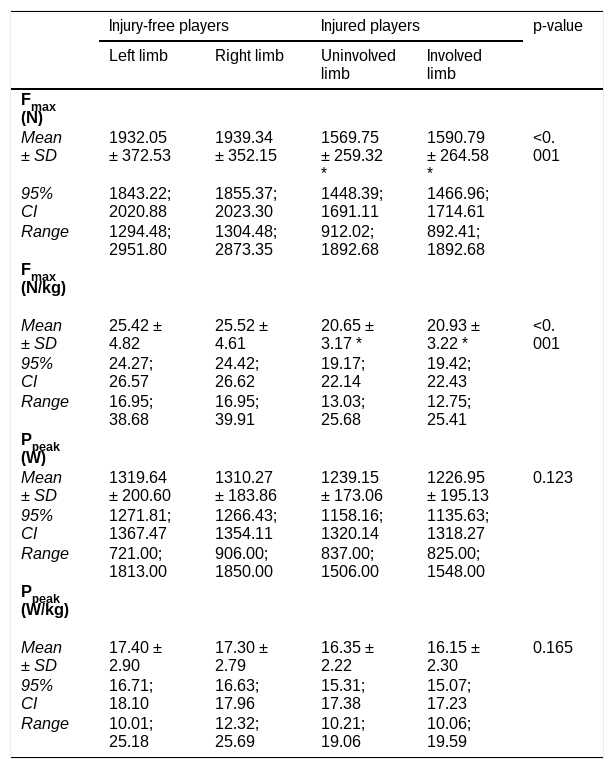
At the end of the OFR stage, Fmax and Ppeak values were similar between the involved and uninvolved limbs of the injured players (p > 0.05; Table 2, Fig. 2). Additionally, Ppeak values in the injured players were comparable to those of the left and right limbs of injury-free players (p > 0.05; Table 2, Fig. 2). In contrast, both limbs of the injured players exhibited significantly lower Fmax values, both in absolute terms and when normalized by body mass, compared to injury-free players (p < 0.001; Table 2, Fig. 2). The effect sizes relative to the left and right limbs of the injury-free group were large for both the uninvolved limb (d = 0.96–1.02) and the involved limb (d = 0.99–1.05).
Maximum force (Fmax) and peak power (Ppeak) in injury-free and injured players.
| Injury-free players | Injured players | p-value | |||
|---|---|---|---|---|---|
| Left limb | Right limb | Uninvolved limb | Involved limb | ||
| Fmax (N) | |||||
| Mean ± SD | 1932.05 ± 372.53 | 1939.34 ± 352.15 | 1569.75 ± 259.32 * | 1590.79 ± 264.58 * | <0.001 |
| 95% CI | 1843.22; 2020.88 | 1855.37; 2023.30 | 1448.39; 1691.11 | 1466.96; 1714.61 | |
| Range | 1294.48; 2951.80 | 1304.48; 2873.35 | 912.02; 1892.68 | 892.41; 1892.68 | |
| Fmax (N/kg) | |||||
| Mean ± SD | 25.42 ± 4.82 | 25.52 ± 4.61 | 20.65 ± 3.17 * | 20.93 ± 3.22 * | <0.001 |
| 95% CI | 24.27; 26.57 | 24.42; 26.62 | 19.17; 22.14 | 19.42; 22.43 | |
| Range | 16.95; 38.68 | 16.95; 39.91 | 13.03; 25.68 | 12.75; 25.41 | |
| Ppeak (W) | |||||
| Mean ± SD | 1319.64 ± 200.60 | 1310.27 ± 183.86 | 1239.15 ± 173.06 | 1226.95 ± 195.13 | 0.123 |
| 95% CI | 1271.81; 1367.47 | 1266.43; 1354.11 | 1158.16; 1320.14 | 1135.63; 1318.27 | |
| Range | 721.00; 1813.00 | 906.00; 1850.00 | 837.00; 1506.00 | 825.00; 1548.00 | |
| Ppeak (W/kg) | |||||
| Mean ± SD | 17.40 ± 2.90 | 17.30 ± 2.79 | 16.35 ± 2.22 | 16.15 ± 2.30 | 0.165 |
| 95% CI | 16.71; 18.10 | 16.63; 17.96 | 15.31; 17.38 | 15.07; 17.23 | |
| Range | 10.01; 25.18 | 12.32; 25.69 | 10.21; 19.06 | 10.06; 19.59 | |
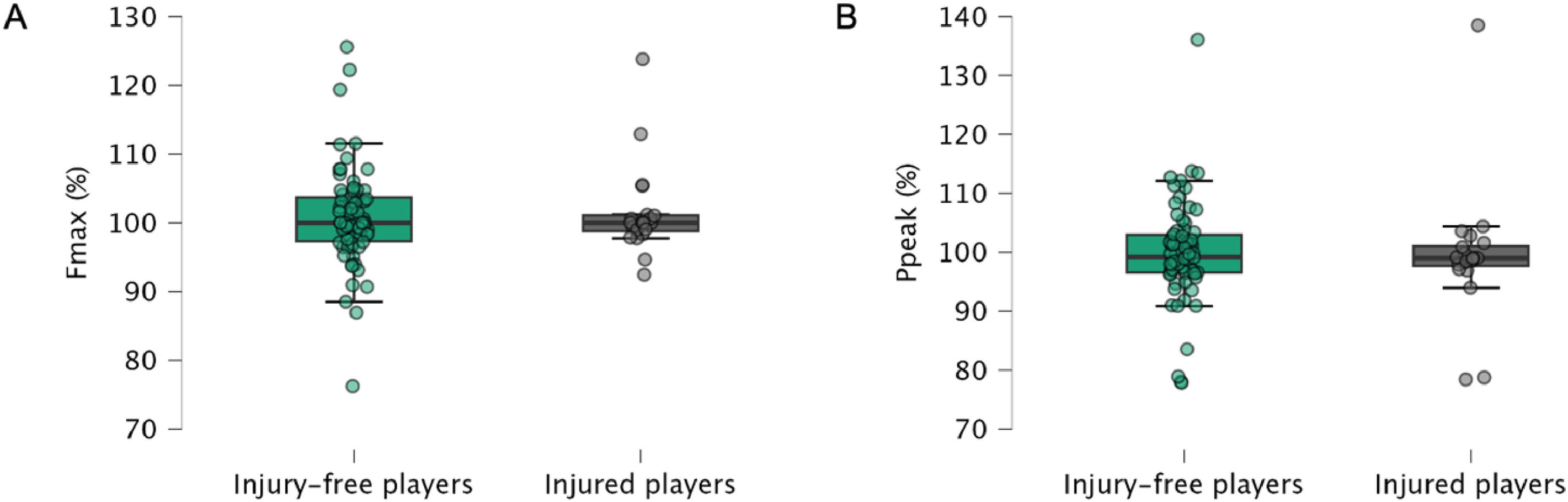
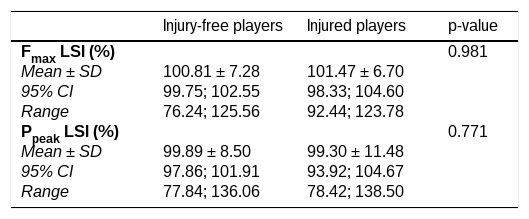
LSI values for both Fmax and Ppeak were similar between injured and injury-free players (p > 0.05; Table 3, Fig. 3). At the individual level, none of the injured players presented an LSI <90% for Fmax, and only two players had an LSI <90% for Ppeak (Fig. 3).
Limb symmetry index (LSI) calculated from maximum force (Fmax) and peak power (Ppeak) values in injury-free and injured players.
CI, confidence interval; Range, lowest and highest values; SD, standard deviation.
The present study investigated the status of lower limb strength and power assessed by pneumatic leg press in elite male football players following a unilateral thigh muscle strain injury. Our findings revealed that athletes at the end of the OFR stage presented no significant asymmetry between the involved and uninvolved limbs. The power output of these players did not differ from the normative values observed in injury-free players. Conversely, the maximum force of the injured group was lower than the teams’ normative values.
A sudden decrease in muscle strength is one of the primary consequences of muscle strain injuries.7,8 Given that muscle power depends on force production capacity,34 a concomitant decrease in power would also be expected following such injuries. A gradual restoration of strength has been observed as rehabilitation progresses.35 Consequently, strength assessments play a crucial role in return-to-sport decision-making for athletes who sustained muscle strain injuries.22–24 Concurrently, tests that estimate lower-limb power, such as hop tests, have often been recommended within the testing battery targeting a safer return to sport.22,23 Nevertheless, there is a limited number of studies reporting the strength and power status of high-performance athletes at the time of clearance or during their early return to sports practice.36,37 Although some evidence suggests impairments in the rate of force development38 and horizontal rapid force production during sprinting39,40 after muscle injury, to the best of our knowledge, no study to date has proposed a rehabilitation progression criterion based on lower-limb muscle power for athletes recovering from such injuries.41 Despite the potential advantages of the pneumatic leg press—such as more precise assessment of theoretical maximal force and maximal unloaded velocity due to reduced inertia and minimal influence of body weight—and its recognition as a valuable tool for assessing performance and monitoring training adaptations,42 no studies to date have explored its application in rehabilitation.
Findings from a systematic review by Maniar et al.43 suggest that isometric strength deficits resolve within 2 months following a hamstring strain injury, whereas dynamic strength recovery appears to be delayed. Sanfilippo et al.44 were the first to assess isokinetic strength at the time of return to sport following a hamstring strain injury, reporting a significant strength deficit in the involved compared with the uninvolved limb among recreational athletes. Subsequent findings in professional footballers indicated that two out of three athletes returned to sport with >10% interlimb asymmetry in isokinetic strength tests,36 with some studies notably reporting persistent strength deficits in the involved limb for up to 18 months after a hamstring strain injury.45–47 In addition to these strength deficits, professional footballers with a recent history of severe injury have also been shown to exhibit reduced lower-limb power, as assessed by jump tests.48,49 Given this evidence, it was reasonable to hypothesize that the injured players in this study would exhibit lower performance in the pneumatic leg press test in the involved limb; however, this hypothesis was not supported by our findings.
Using the performance of the contralateral limb as a reference for assessing the recovery status of the injured limb is a common practice in both research and clinical settings.25 However, the lower strength values observed in both limbs of injured players compared with injury-free controls raise an important concern regarding the use of the uninvolved limb as a normative reference, as interlimb symmetry may mask bilateral deficits. The maximum force of approximately 1580 N, representing the average across the two limbs in injured players, was approximately 18% lower than the 1935 N observed in injury-free players. Our findings align with those of Van Dyk et al.,37 who found that while strength values were reduced in professional male footballers returning to sport after a hamstring strain, the side-to-side strength differences were similar to pre-injury levels. This may explain why interlimb strength symmetry measured at the time of return to sport did not differ between those who did and did not re-injure within the first 2 to 3 months.36,50 In short, the evidence underscores the importance of not only assessing the strength or power balance between the involved and uninvolved limbs but also carefully considering pre-injury values or normative data from the specific population.
Our findings indicate that athletes completing the rehabilitation programs implemented by the participating clubs exhibited interlimb strength and power symmetry; however, their strength levels remained lower than the normative values observed in a sample of injury-free players. The retrospective nature of the current study limits our ability to determine whether the observed differences in strength resulted from the injury or whether the athletes already had lower strength values before sustaining the injury. If the former is the case, the lower strength observed in the uninvolved limb may reflect detraining due to time away from the regular training routine. Additionally, athletes may return from injury with some degree of apprehension during maximal strength tests,51 which could further limit their performance on the pneumatic leg press. However, these explanations should be interpreted as hypotheses, as these factors were not directly measured in the present study. Regardless of the underlying cause, it is important to note that lower levels of muscular strength have been associated with a greater risk of muscle injuries.15,18,19,52 Therefore, returning athletes to sport with strength levels below their pre-injury capacity may be suboptimal. If the strength differences between injured and injury-free players in the current study reflect pre-existing differences, this highlights the importance of individual pre-injury strength values when making return-to-sport decisions. Nevertheless, consistent in-season monitoring remains essential to track changes over time.
Contrary to maximum force, peak power values for both limbs in the group with unilateral muscle injury were similar to those of the injury-free reference group (∼1232 ± 182 W vs. ∼1315 ± 192 W). This discrepancy between strength and power outcomes may have several explanations. Rehabilitation programs may emphasize functional movements that prioritize ballistic actions, potentially contributing to the recovery of power despite residual deficits in maximum strength.53 Interestingly, hamstring strength deficits observed during slow eccentric actions have not been reproduced at faster isokinetic speeds, either eccentrically or concentrically,43 which is consistent with our findings. One potential advantage of assessing muscle power is that it may better reflect functional recovery than maximal strength tests, which typically do not mimic football-specific tasks and may therefore be less sensitive to an athlete's ability to perform high-speed sport-specific actions.54 Given the intermittent nature of football and its frequent ballistic actions, the restoration of normal muscle power during OFR may provide additional reassurance to medical and performance staff.
While the specific contribution of individual muscles during the pneumatic leg press remains largely unexplored, studies using other leg press modalities consistently report greater activation of the vastus lateralis and medialis, followed by the rectus femoris.55 However, muscle activation patterns are highly dependent on knee joint angle; for instance, activation of the biceps femoris and medial gastrocnemius tends to increase with knee extension, whereas activation of the vastus lateralis, vastus medialis, rectus femoris, quadriceps, and tibialis anterior decreases.55 Given that the majority of injuries in the current study were hamstring-related, the leg press test may have limited sensitivity to accurately assess strength recovery in this muscle group. Nevertheless, its multi-joint, synergistic nature may better reflect sport-specific motor tasks than isolated, single-joint isokinetic or isometric evaluations, making it a potentially valuable tool for football-specific assessment.
This study has limitations that should be acknowledged. First, the reliability of the pneumatic leg press test was not assessed in our sample; therefore, reliability data from a previous cohort of footballers were used as a reference.27 Second, the small sample size, particularly for quadriceps and hip adductor injuries, precluded meaningful analyses by injured muscle group. Third, not all athletes in the injured group had participated in the preseason assessments used to establish the injury-free reference values, precluding direct comparisons of strength and power before and after the muscle strain injury in the same 20 athletes. Fourth, detailed information on the activities and workload performed during OFR was not collected, although previous research has shown that practitioners tend to follow up-to-date international guidelines and consensus recommendations during this late rehabilitation phase.56 Finally, we did not have access to post-study data, which could have provided insights into injury recurrence rates, although monitoring recurrence was not a primary aim of this study.
On the other hand, the innovative testing approach represents a strength of this study. The pneumatic leg press may provide a reproducible and quick-to-perform assessment that simultaneously quantifies lower-limb strength and power during a closed-kinetic-chain movement, potentially better reflecting the functional demands of football. This study provides practitioners with normative data from a representative sample of injury-free male football players competing at the elite Brazilian level, as well as novel data from players undergoing late-stage rehabilitation following muscle injury. However, reference values for other football populations, including female, youth, and amateur players, remain to be established. The potential role of pneumatic leg press results in return-to-sport decision-making warrants further investigation, particularly in prospective cohort studies with larger samples and injury recurrence monitoring, ideally combining this assessment with other commonly used tests in sports settings, such as isokinetic testing and jump performance.
ConclusionThis study provided normative values for maximum force and peak power measured using a pneumatic leg press test in elite male football players. Those completing the OFR stage following a thigh muscle strain injury displayed similar force and power between the involved and uninvolved limbs. Although peak power in injured players was comparable to that of injury-free players, maximum force was lower than the normative values. These findings suggest that interlimb symmetry should not be interpreted in isolation but considered alongside pre-injury or normative reference values to support more informed return-to-sport decisions when using the pneumatic leg press test.
FundingThis research did not receive any specific grant from funding agencies in the public, commercial, or not-for-profit sectors.
The authors declare that they have no competing interests.
B.M.B. thanks CNPq-Brazil for the research productivity fellowship.